
Built in Austin. Trusted worldwide.
Enterprise WiFi management. One person, 100 AI agents, 20 years of code.
From a garage in Germany to enterprise WiFi.
It started in 2004. Not as a startup. As a services team building networks where uptime is not optional. Over twenty years a small crew of researchers, engineers, and field operators delivered the kind of work that does not show up on a press release. Seventy-two portable router prototypes for Bundeswehr research programs, later transitioned into series production. Mission-critical mesh networks for the German Aerospace Center under contract through 2035. Firmware running across 560 bank locations for thirty plus regional savings banks. Mesh systems for explosive industrial environments in Linz. Guest WiFi for thousands of hospitality locations across DACH. Research mesh for universities in Kaiserslautern, Madrid, and Darmstadt. Foot-traffic analytics for Coca-Cola Germany feeding directly into SAP.
Cloud-managed. Military standards. Their own protocols. Their own deep firmware. More than twenty Linux microservices wrapped into one image that fits in five to ten megabytes. For context: a single iPhone photo is about three megabytes. The whole Airfy network operating system, including AI tooling, identity, voice, mesh, captive portal, and routing, is the size of two photos. That is twenty years of optimization.
For most of those years the team operated quietly across Europe. Customers were almost entirely European. Coca-Cola Germany was the early American thread. The brand stayed behind the work.
Then 2026 happened. The FCC banned a generation of foreign consumer routers and critical infrastructure suddenly needed network technology that was already mature, already shipping, already audited by a team that had been at this for two decades. Airfy came out from behind the curtain. Built the public brand. Opened the AI Academy.
The mission is simple now. Make seriously good WiFi for America and the world. Built by people who shipped it for twenty years before they ever had a marketing department.
The two people behind Airfy.
Fifteen years researching network infrastructure. Travelling the world while building the layer that quietly carries the AI everyone is talking about.

Steffen Siewert
Do-it-yourself engineer. Autodidact. In love with infrastructure and operating systems the way other people are in love with cars or wine.
Two decades of building, deploying, and managing networks. Built the firmware, the cloud platform, and the AI agent team from scratch — one founder who spent twenty years in the field before writing a line of platform code.
His mission: build the best version of the network layer there is. One that protects you, one you can trust, and one that is open.

Mona
Mona runs the Airfy AI Academy and partner enablement. Her job is making sure every Airfy partner can sell, deploy, and earn with the platform.
Before Airfy she led the digital transformation of a Swiss hospital. She knows what it takes to bring complex technology into a real working organisation. The Academy is built on that experience: small live cohorts, hand-picked materials, every question answered personally.
If Steffen builds the layer that protects you, Mona is the one who teaches Airfy partners how to make a living with it.
Modern AI rests on four foundational layers: applications, models, infrastructure, and silicon. We work in the infrastructure layer. Specifically the network that connects every device, every model, every workload. It is the layer that decides whether everything above it works in the real world. Twenty years of research. Same focus, every day.
One of the core outputs of that research: an AI-Linux that runs on 1,500 device types. Routers, switches, IoT gateways, robots, and consumer machines (Sonos, Thermomix, vacuums). Same firmware, same security policy, same agent surface. Manufacturer-mode lets any vendor ship Airfy as their AI-Linux layer.
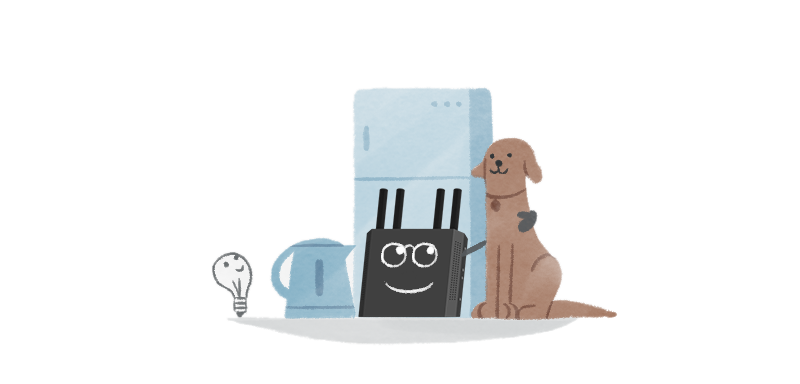
What we stand for.
Multi-Vendor Freedom
Runs on the hardware you already own. 1,500+ supported boards across all major manufacturers. No forklift upgrades, no rip-and-replace.

Family-Driven
Independent and family-driven. We build what our customers need, not what looks good in a pitch deck.
Speed of Updates
In the agentic-AI era, what matters is how fast security patches and AI capabilities reach every device. Our full-stack platform ships firmware updates in hours, not months.
AI-Auditable Infrastructure
The entire technology stack, from firmware to cloud, can be continuously analyzed by modern AI security tools. 240+ MCP tools inspect, test, and harden every layer in real time.
This is what an AI-native company looks like.
Two founders at the centre. Around them, a small circle of domain experts — veterans of critical networking, firmware, and Linux — people we have been doing research with for over ten years. AI agents handle the rest: support, monitoring, firmware rollouts, compliance, onboarding. A small team with the output of a large one.
Router firmware (9 MB, 31 services), a cloud platform (200+ microservices), and AI agents that tie it all together. We go beyond networking into IoT, WiFi HaLow, and voice-controlled infrastructure — because that is where the research keeps pulling us.
100+
AI agents in production
200+
Cloud services
1,500+
Devices supported
20+
Years of network code
Agents do the work
Support tickets, firmware rollouts, compliance reports, network diagnostics. AI handles the repetitive work so the team can focus on building.
WiFi will manage itself.
Every device, every location. Controlled by voice and chat. Self-healing, self-optimizing, self-reporting. The admin sets the policy. The AI runs the network.
Self-managing networks
Firmware updates, channel optimization, client balancing. All automatic.
Beyond WiFi
IoT sensors, WiFi HaLow for long range, edge computing. The AP becomes a platform.
US partners on the bench
When customers need US-made hardware, we ship through US manufacturing partners. We do not manufacture; we do install on 1,500+ boards from any vendor.
Built in Texas. Serving the world.
The American version of Airfy is engineered, hardened, and assembled in the United States. The European version is built in Europe. Two jurisdictions, one codebase, no shortcuts.

Austin, Texas
Airfy Inc. - US Headquarters
The heart of Airfy in the US. Product, engineering, and customer success. Austin's tech ecosystem gives us access to top talent and infrastructure.
Portugal
AirZen Networks Lda. - EU Operations
Our European home. Engineering, EU operations, and the team that ships the European version. Direct fiber links between Lisbon, Madeira, and London. Built where the founders live and travel.